The honest answer
Not always. And a firm that only tells you when you need its services, never when you do not, is a vendor, not an advisor.
An independent assessment of a transformation decision is a specific tool for specific situations. There are circumstances where it adds disproportionate value, and circumstances where it adds little or none. Knowing the difference is part of the advice.
The situations where independent assessment creates disproportionate value are well-defined: material investments, irreversible decisions, business cases built by parties with a stake in the outcome, and programmes where governance has eroded. The rest of this article is about the cases that fall outside those situations.
When the cost of assessment is disproportionate to the risk
The core argument for independent assessment rests on base rates: 91.5% of projects exceed budget or timeline, and the median IT cost overrun is 73% (Flyvbjerg and Gardner, 2023). But these are averages across all project sizes. The Standish Group's CHAOS 2020 data shows a marked size effect: small projects succeed at high rates, while large projects succeed at much lower rates (Standish Group, 2020). The split is steep enough that scale itself is one of the strongest single predictors of outcome.
The implication is practical. A 500,000 process improvement with a proven vendor and a clear scope does not need independent assessment. The cost of the assessment would be disproportionate to the residual risk, and the organisation's own judgment is typically sufficient at that scale. A 40 million ERP replacement with a new vendor and an ambitious timeline has a fundamentally different risk profile. The assessment pays for itself many times over.
A 500,000 process improvement does not need independent assessment. A 40 million ERP replacement does.
The threshold is not a fixed number. It depends on the size of the investment relative to the organisation, the complexity of the programme, the reversibility of the decision, and the degree to which the business case has been independently validated. But as a practical guide: when the investment is material to the organisation and the decision is difficult to reverse, independent assessment is relevant.
When the organisation already has the capability internally
Some organisations have built internal capability for independent assessment. Large financial services groups often have a transformation office or an investment review function that performs structured assessment of major decisions before they reach the executive committee. Public sector bodies in the UK have used reference class forecasting systematically since the early 2000s. In these organisations, the function exists internally and operates with formal independence from the project teams whose work it assesses.
Where this capability exists and is genuinely independent (commissioning, reporting line, and incentive structure), external assessment adds little. The question to test is whether the internal function reports to the same executives whose programmes it assesses. If it does, the structural independence is incomplete, and external assessment may still add value precisely because it sits outside that reporting structure.
When the decision has already been made
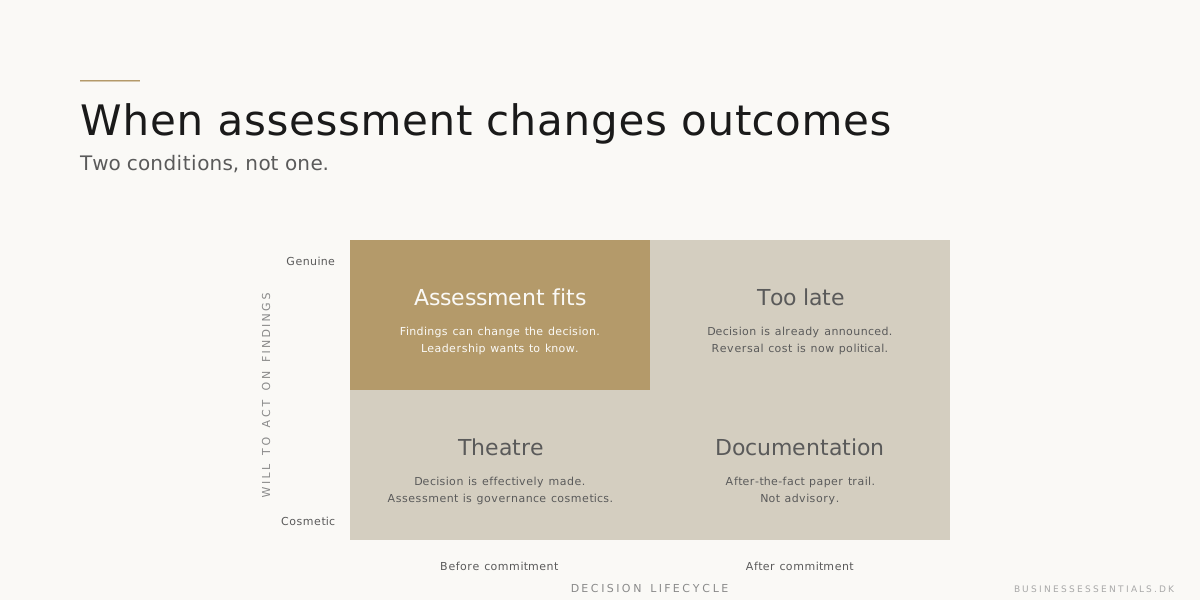
An assessment commissioned after the contract is signed, the vendor is selected, and the steering committee has approved is not an assessment. It is a confirmation exercise. The cost of changing course has already become high enough that the recommendation, however well-calibrated, will be difficult to act on.
This is not a hypothetical pattern. It is the most common reason for organisations making contact too late. The conversation typically begins: "We are six months into this programme and things are not going as planned. Can you assess whether we should continue?" The honest answer is sometimes yes; a Transformation Guardrail Review at month six can still meaningfully change the trajectory. But for decisions that are functionally irreversible, the appropriate intervention is no longer assessment of the original decision; it is assessment of the available paths forward.
The relevant question for the original decision was the one that should have been asked before the contract was signed. Once that moment has passed, the tool changes.
When the decision is genuinely reversible
Some transformation decisions are reversible at low cost. Pilot programmes with clear stop conditions. Software deployments that can be unwound within the contract terms. Organisational changes that can be reverted within a reasonable timeframe. Where reversibility is genuine and the cost of reversal is contained, the case for upfront independent assessment is weaker. The organisation can learn from execution and adjust.
The test for genuine reversibility is structural, not rhetorical. Many decisions are described as pilots that are in fact difficult to reverse: data has been migrated, vendor relationships have been built, internal capability has been redirected. A pilot that has accumulated those dependencies is no longer a pilot. The reversibility test should be applied honestly: what would it actually cost to stop, and how much of the investment would be unrecoverable?
When the question is operational rather than structural
Independent assessment is a tool for evaluating decision quality. It is the wrong tool for evaluating operational performance, technical implementation choices, or vendor delivery against agreed scope. Those questions are typically better answered by audit, technical review, or contract management.
The line between structural and operational is not always clear. A question framed as operational ("are we on track?") may turn out to be structural ("was this the right decision in the first place?"). The reverse can also be true. The discriminating test is whether the question being asked depends on the validity of the original business case. If it does, independent assessment is relevant. If it depends on the quality of execution against an unchanged business case, other tools are typically more appropriate.
When the conversation should still happen
Even in the situations above, a 30-minute conversation often clarifies whether assessment adds value or not. The honest answer is sometimes no. That answer, given clearly and early, is more useful than an engagement that produces a report no one acts on.
The discriminating filter is not a sales-qualification process. It is a working hypothesis that gets tested in conversation. Some situations that look like they need assessment do not. Some that look like they do not, do. The point of the early conversation is to find out which one applies.
A signal that the conversation is worth having despite the discriminating filter: the situation looks like a no-assessment case but the underlying decision is material to the organisation. If that signal is recognised, the cost of testing it in 30 minutes is bounded; the cost of being wrong about which side of the line the situation falls on is not.