The short answer
Independent AI advisory provides assessment of an organisation's AI strategy, readiness, governance, and vendor selection by a party with no commercial interest in the outcome. It exists because the structural conflict between advice and implementation is more pronounced in AI than in almost any other transformation domain.
Why AI is different
The market for AI services is dominated by firms that simultaneously advise on AI strategy and sell AI implementation. Most major consulting firms have hyperscaler partnerships, model provider relationships, or proprietary AI platforms they want to deploy. The same firm that recommends an AI strategy is often the firm that benefits financially from the recommended path.
This is not a hypothetical concern. The pattern is visible in the empirical data. McKinsey reports that 78% of organisations now use AI in at least one business function (McKinsey, State of AI 2025). Yet IDC and Lenovo found in 2025 that 88% of AI pilots fail to scale to production despite technical success. The gap between technical capability and organisational realisation has not closed. If anything, it has widened.
88% of AI pilots fail to scale despite technical success. The problem is not the technology.
The problem is rarely the technology itself. McKinsey's State of Organizations 2026 report finds that organisations that invest disproportionately in change management report no significant difference in outcomes from those that do not (McKinsey, State of Organizations 2026, n=2,127). The conventional advice on change management has not produced the expected return when applied to AI specifically.
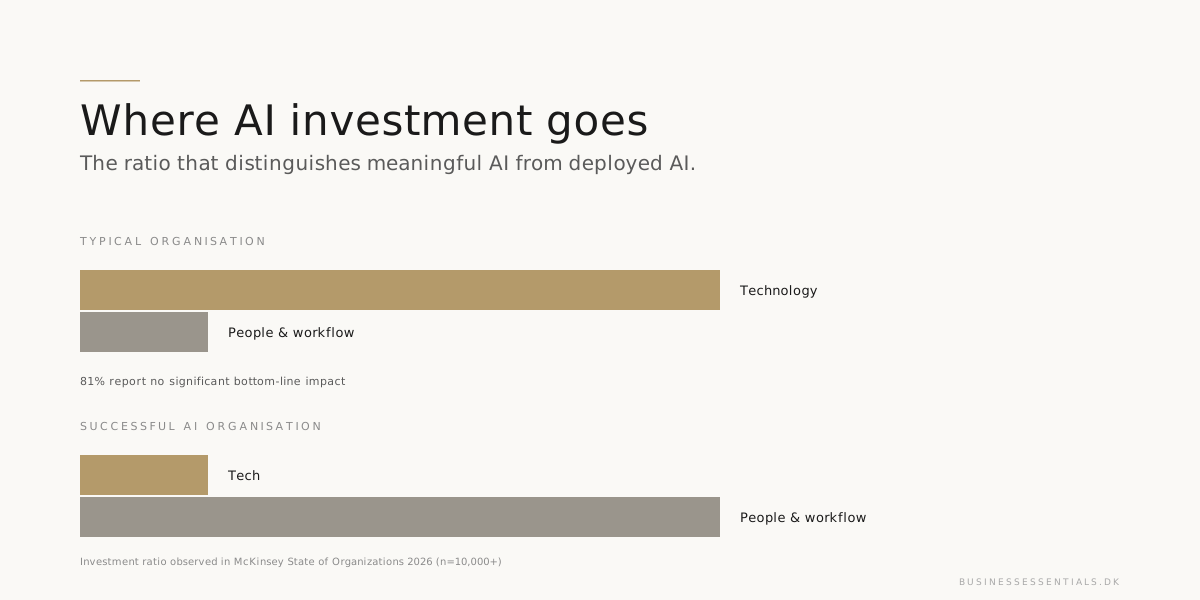
Something more structural is at work. Organisations are buying AI capability faster than they are building the workflow integration, governance, and operating model required to realise value from it. Independent assessment of these gaps, before commitment, is what AI advisory exists to provide.
What it covers
AI advisory typically covers five domains.
Maturity assessment. Where is the organisation today across data foundations, model deployment, governance, talent, and operating model? Maturity assessments are widely available, but most are produced by firms that benefit from selling the capability gaps they identify. Independent maturity assessment is calibrated against published benchmarks and produces a baseline that can be tested rather than a roadmap that produces revenue.
Strategy assessment. Does the AI strategy address questions that materially affect competitive position, or is it organised around technology categories that map to vendor offerings? AI strategies that begin with capability inventories tend to produce technology shopping lists. AI strategies that begin with decision questions produce calibrated investment cases.
Readiness assessment. Is the organisation ready to deploy AI in specific use cases, or are there structural gaps in data quality, workflow integration, or change capacity that will limit value realisation? This is the single most consequential assessment domain. Most failed AI pilots fail not because the model did not work, but because the organisation could not absorb the change at the speed required.
Governance advisory. Are model governance, data governance, and risk management appropriate for the use cases being deployed? AI governance is regulated unevenly across jurisdictions. The EU AI Act introduced binding obligations in 2024 that materially affect risk classification, documentation requirements, and human oversight. Organisations that adopt AI without commensurate governance accumulate liability faster than they accumulate value.
Vendor analysis. Are the selected vendors and platforms calibrated against alternatives, or has vendor selection been driven by relationship, brand, or precedent? Vendor analysis is the domain where the structural conflict in non-independent advisory is most pronounced. A firm that recommends Vendor X cannot simultaneously be the firm that audits whether Vendor X was the right choice.
What independence specifically requires
Three structural conditions distinguish independent AI advisory from the broader AI consulting market.
No partnership revenue. No financial incentive from any AI vendor, hyperscaler, or platform provider. No co-marketing arrangements, no referral fees, no implementation contracts that depend on a specific vendor selection.
No implementation work. The advisory firm assesses and recommends. It does not build, deploy, or operate the AI capabilities it evaluates. The boundary is what makes the assessment independent.
Empirical calibration. Recommendations are calibrated against published research and reference data, not against proprietary frameworks that produce predictable conclusions.
The scaling problem in detail
The 88% pilot-to-scale failure rate deserves closer examination, because it reveals what AI advisory needs to address that standard transformation advisory does not.
Pilots succeed because the conditions for success can be controlled: a curated dataset, a willing user group, a focused use case, and direct technical support. Production deployment cannot replicate any of these conditions. The data is messier, the users are unselected, the use cases multiply, and technical support is at arm's length.
Most AI strategies are written for the pilot phase. They optimise for proof of concept rather than for production realisation. Independent assessment surfaces this gap before the investment is committed, by examining whether the organisation has the workflow integration, governance, and change capacity to convert technical capability into operational value.
A signal that this pattern applies to a specific decision: the AI investment business case quantifies the technology cost precisely (licences, compute, model fees) but treats the organisational integration cost as a residual category. If that signal is recognised, the work of separating those costs now is bounded; the cost of discovering them during scaling is not.