The inversion
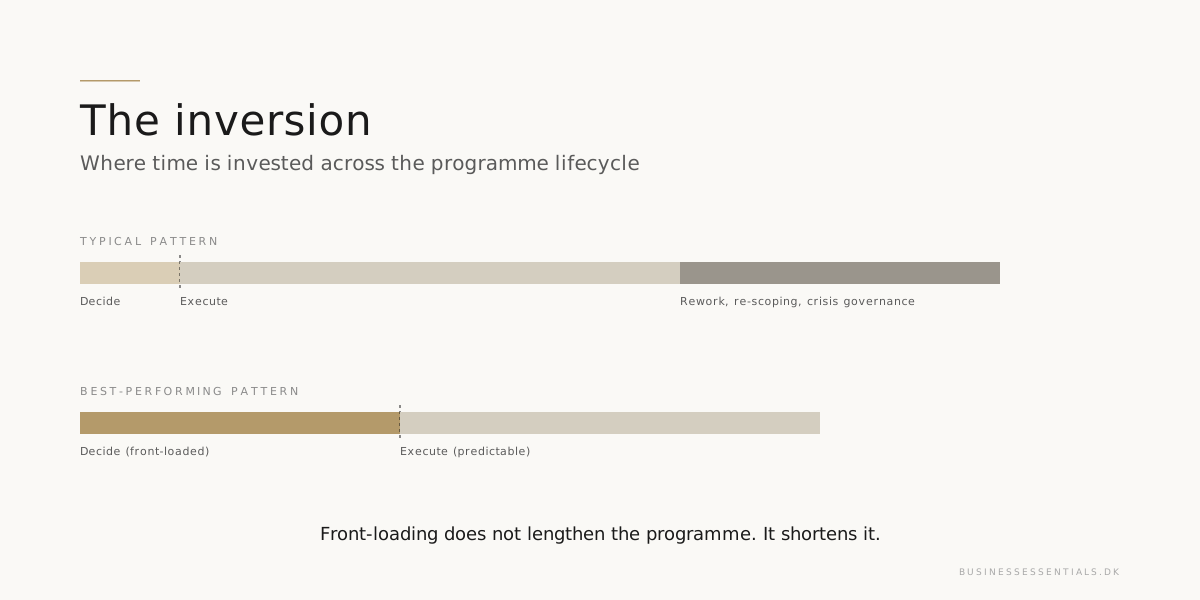
Most large transformations get the sequence backwards. The decision is fast: a business case built in weeks, approved in a single board meeting, committed before the organisation has tested its own assumptions. The execution is slow: years of delays, rework, scope changes, and crisis-mode governance.
The best-performing projects in Bent Flyvbjerg's database of 16,000 programmes across 136 countries invert this pattern. They invest disproportionately in deciding what to do, and execute faster because the plan is realistic, the risks are known, and the organisation is genuinely ready (Flyvbjerg and Gardner, 2023).
Flyvbjerg calls it "think slow, act fast." It is one of the structural patterns that separates projects landing in the manageable range of variance from those landing in the long tail of catastrophic overruns.
The best-performing projects invert the typical pattern. They invest disproportionately in deciding what to do, and execute faster because the plan is realistic.
What the data shows
The base rates are not subtle. Across the full database, 91.5% of projects exceed their budget, their timeline, or both. Less than 1% deliver on time, on budget, and with the expected benefits (Flyvbjerg and Gardner, 2023). The database is weighted toward large and mega-projects, so these specific ratios apply most directly at programme scales above approximately USD 100 million. The structural pattern persists at smaller scales, but the precise numbers should be read as directional rather than exact for mid-cap transformations. For IT projects specifically, cost overruns follow a power-law distribution rather than a normal one, which means extreme overruns happen far more often than standard risk models predict (Flyvbjerg et al., 2022, n=5,392).
The pattern repeats across every domain that has been studied. McKinsey, in collaboration with Oxford's BT Centre for Major Programme Management, analysed 5,400 large IT projects and found that 45% ran over budget, 7% ran over time, and 56% delivered less value than predicted (McKinsey-Oxford, 2012). Bain reported in 2024 that only 12% of business transformations achieve their original ambition.
What the long-form research consistently finds is that the small minority of projects that succeed share a structural feature: they front-loaded the investment in deciding rather than the investment in doing.
Why organisations resist slow thinking
There is enormous pressure to move quickly. The vendor has a timeline. The market window is closing. The CEO announced the initiative at an all-hands meeting. The project team is staffed and billing.
The urgency is almost always real. It is also almost always the wrong reason to skip validation. The cost of a four-week independent assessment is trivial compared to the cost of discovering in month eight that the business case was built on vendor projections nobody validated, that organisational readiness was assessed by the people who needed the project to proceed, and that the alternatives were never seriously evaluated.
The urgency is almost always real. It is also almost always the wrong reason to skip validation.
The pressure to move fast often comes from the same parties whose interests are served by avoiding scrutiny. The implementation partner has no incentive to surface concerns about the business case. The internal sponsor has invested political capital in the announcement. The vendor's commercial model depends on the timeline staying intact. Slow thinking is institutionally inconvenient.
None of this implies that organisations under pressure have made the wrong decision. The pressure is structural, not personal, and the people inside it are typically responding rationally to the incentives in front of them. The point here is narrower: structural pressure rarely improves the quality of the decision basis, and the cost of testing the underlying assumptions is typically lower before commitment than after.
Reintroducing structured discipline midway through a programme is harder than getting it right at the start, but it is not impossible. The most common entry points are scope changes, leadership transitions, and scheduled governance reviews: moments when the organisation is already pausing, and a calibrated outside view can be folded into the existing decision process without requiring anyone to admit error.
What slow thinking actually involves
It is not delay for its own sake. It is structured discipline applied to the decision basis before commitment. In practice, this means four things.
First, calibrating the project against a reference class of comparable programmes rather than against its own internal projections. Daniel Kahneman described this as taking the outside view: asking what happened to projects like this one, rather than what is expected to happen to this one. The empirical reality is that internal projections are systematically optimistic. Reference class forecasting corrects for this without relying on individual judgment.
Second, testing the assumptions underneath the business case. Most business cases rest on three or four critical assumptions about adoption, integration complexity, organisational readiness, and benefit timing. When these assumptions are made explicit and stress-tested, the realistic ranges are typically far wider than the business case suggests.
Third, assessing organisational readiness empirically rather than directionally. The Holt et al. Readiness for Organisational Change instrument measures four dimensions, of which the strongest predictor of resistance is the perceived appropriateness of the change. Scores below the midpoint correlate with substantial resistance during execution (Holt et al., 2007). A management team's confidence that the organisation is "ready" is not the same as evidence that it is.
Fourth, identifying what the change-management research consistently finds is the single strongest predictor of success: active, visible executive sponsorship throughout the programme, not just at launch. Prosci's data from more than 6,000 projects shows that programmes with strong sponsorship are six to seven times more likely to meet their objectives than those without (Prosci, 2023).
None of these activities are exotic. They are simply not done at the depth required, because the calendar pressure is real and the alternative looks like delay.
The economics of pre-decision investment
The time invested in slow thinking does not lengthen the programme. It substitutes for time that would otherwise be spent on rework, re-scoping, and crisis-mode governance, paid in months after the original commitment rather than weeks before. The organisations that produce predictable execution have not eliminated the cost. They have moved it to where it is cheaper.
The cost of slow thinking is paid in calendar weeks before commitment. The cost of skipping it is paid in months after.
The economics are visible in the data. McKinsey's research on what it calls the Five C's of transformation found that active sponsorship across the full programme correlates with a threefold increase in success rate (McKinsey, 2022). BCG's research on transformation success identified six factors that, when combined, raise the probability of success from approximately 30% to closer to 80% (BCG, 2020/2024). The factors are not secrets. They are routinely missing because they require front-loaded investment in capability, governance design, and stakeholder alignment that organisations under timeline pressure deprioritise.
The math is straightforward. A two-to-four-week assessment that costs a fraction of a percent of programme value, conducted before commitment, materially shifts the probability distribution of outcomes. It does not guarantee success. It calibrates the decision against what is empirically known about projects of this type, and it identifies the assumptions and gaps that, if left unexamined, are most likely to produce the failure modes the data predicts.
When the inversion does not work
The argument applies to discretionary transformation programmes, where the timing of the decision is itself a choice. There are situations where it does not apply at all. Compliance deadlines, regulatory enforcement actions, cyber-incident response, and acute liquidity events are contexts where additional pre-decision time can itself increase risk through fines, exposure, or loss of market access. When speed is the structural requirement, the relevant question is not whether to think slowly, but how to think well within the time available.
Within the discretionary programmes the argument does cover, slow thinking only changes outcomes when the organisation is willing to act on what it learns. An assessment that produces a clear-eyed view of the risk profile, and is then filed away because the political cost of changing course is too high, is a different exercise. It looks like governance. It functions as theatre.
This is a narrow definition. Many governance activities have legitimate value without changing decisions: creating a contemporaneous record, building shared language across stakeholders, satisfying fiduciary or regulatory requirements. The point here applies specifically to assessments commissioned to inform a decision, that are then set aside by the people who commissioned them.
An assessment that does not change the decision is not advice. It is theatre.
The signal that an organisation is positioned to benefit from slow thinking is specific: leadership genuinely wants to know what could go wrong, and is structurally able to act on that knowledge. The signals that the organisation is not positioned to benefit are equally specific. The decision has already been communicated externally. The vendor relationship makes course correction politically expensive. The sponsor's reputation is tied to the original framing.
In those situations, slow thinking will not change outcomes. It may still be valuable for documentation purposes or to satisfy governance requirements, but the underlying dynamic that produces failure is unchanged.
Partial outcomes are common even within those constraints. An assessment may not reverse the core decision but still narrow scope, sharpen contingency, or surface specific assumptions that warrant closer monitoring during execution. Those are smaller wins than full reversals, but they are real, and they meaningfully shift the risk profile that the programme carries into execution.
The same dynamic surfaces later in execution as well. Status reporting on troubled programmes systematically presents as green externally while the underlying signals are red, a pattern KPMG's research on IT project management has documented across many engagements. The watermelon-coloured status report is the late-stage form of the failure that slow thinking is meant to prevent at the front end. By the time the status turns visibly red, the cost of correction is far larger than the cost of an honest assessment would have been at the start.
What this looks like in practice
Independent assessment is one form of structured slow thinking, conducted by parties with no stake in the outcome and no role in the implementation. Its purpose is to bring the empirical outside view into a process that otherwise relies on internal estimates alone, and to make the assumptions underneath the business case visible and testable.
The slow thinking is not external. It is the organisation's. The assessment provides the structured frame within which the organisation does its own thinking with better information than it would otherwise have. The decision remains with the people accountable for it. What changes is the basis on which the decision is made.
This is not a transfer of accountability. The assessment does not move responsibility for the outcome onto the assessor; it improves the information available to those who hold it. When a programme later succeeds or fails, the decision and its consequences remain with the executive who made it. What an assessment provides is a contemporaneous record of what was known, what was tested, and what alternatives were considered.
The organisations that produce the small minority of transformation programmes that succeed are not unusually fortunate, or unusually well-resourced, or unusually skilled at execution. They are the ones that thought slowly before they acted fast.
A signal that the inversion applies to a specific decision: the planned timeline assumes execution will proceed without significant rework, while the organisation's experience with comparable programmes does not support that assumption. If the gap between assumed and likely is recognised, the calendar weeks invested in slow thinking before commitment cost a fraction of the months that rework after commitment will cost.